



Rabi Sowing Guide: What & When to Plant by Krushi Vikas

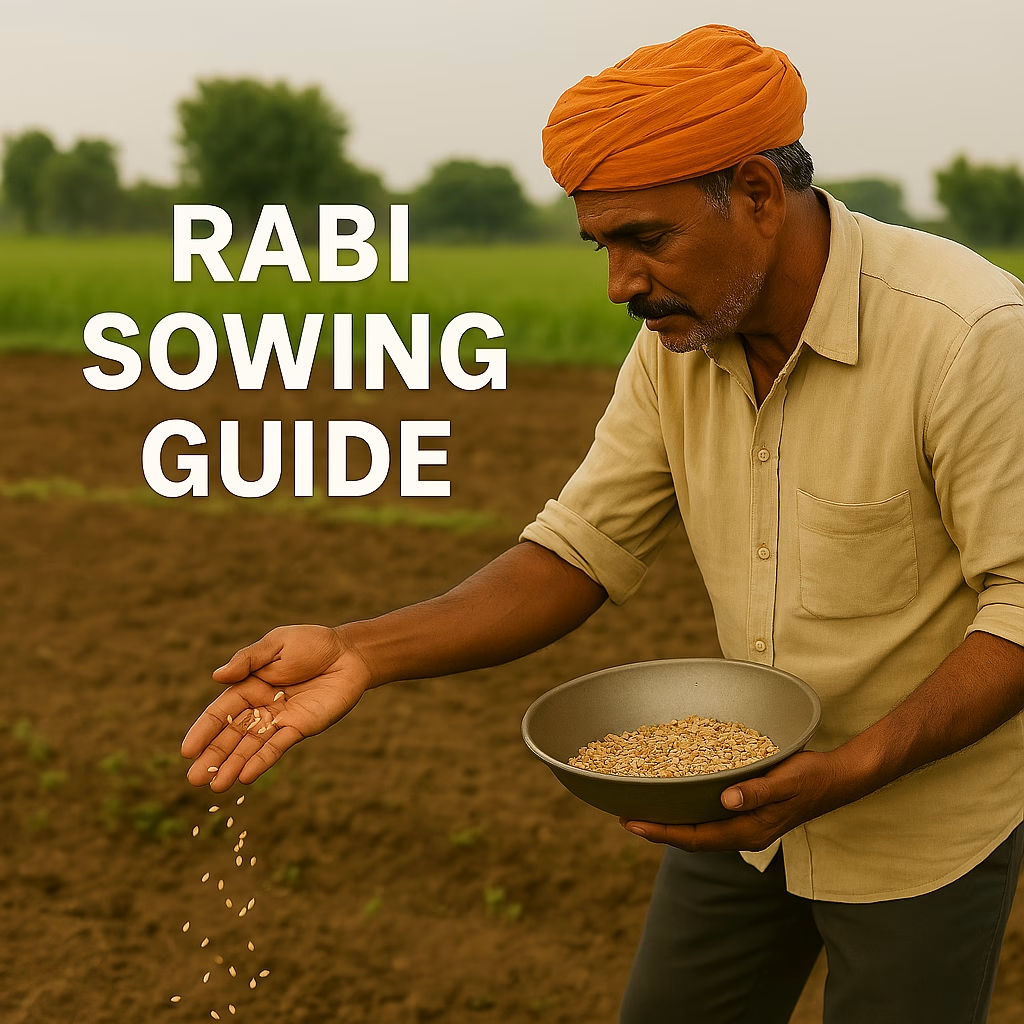
❄️ Harnessing the Cool Season: Your Guide to a Bountiful Rabi Harvest
With the monsoon season ending, it’s time for Indian farmers to gear up for Rabi crops — a season that can yield excellent returns if planned smartly. From wheat and mustard to chickpea and barley, the Rabi season gives farmers a crucial window of opportunity to strengthen their income and maximize yield.
At Krushi Vikas, we’re dedicated to helping you achieve outstanding results in every cropping cycle. In this blog, we present a step-by-step guide to ensure you get the best out of your Rabi season with the right crops, fertilizers, pest management, and harvesting schedule.
🌱 What Are Rabi Crops?
Rabi crops are sown after the monsoon rains, typically between October and December, and harvested from March to April. These crops depend less on heavy rainfall and more on moisture retained in the soil from the retreating monsoon, or on supplementary irrigation. This makes them ideal for areas with proper irrigation facilities or moisture-holding soil.
Common Rabi crops include:
- Wheat
- Barley
- Mustard (Sarson)
- Chickpea (Chana)
- Peas
- Lentils
🗓️ Understanding the Rabi Calendar: When to Sow
The Rabi season generally spans from October to March, with sowing commencing from October to November after the monsoon rains recede. Harvesting typically occurs from February to April, just before the onset of summer. The success of Rabi crops heavily depends on the cool temperatures and the availability of winter rainfall or irrigation.
Generally, sowing begins once the weather turns cooler and the fields are clear of Kharif crops. Therefore, observing local climatic conditions and agricultural advisories from your Krishi Vigyan Kendra (KVK) or state agricultural department is always recommended for precise timing.
Here’s a general guide for major Rabi crops and their sowing times by region:
| Region | Key Rabi Crop(s) | Sowing Time |
| Northern Plains (Punjab, Haryana, UP) | Wheat, Barley, Mustard | Late Oct – Early Dec |
| Central India (MP, Rajasthan, Gujarat) | Wheat, Chickpea, Mustard | Mid Oct – Mid Nov |
| Western/Southern (Maharashtra, Karnataka) | Chickpea, Sorghum, Maize | Early Oct – Mid Nov |
| Eastern (Bihar, West Bengal) | Wheat, Pulses (Lentil, Peas), Maize | Late Oct – Late Nov |
Note: Always follow local agricultural department calendars for the most accurate, region-specific details, as micro-climates and specific varieties can influence optimal sowing windows.
🤾♂️ Step-by-Step Rabi Planning for Indian Farmers
1. Soil Testing & Field Preparation
Firstly, start with a soil test to understand its pH, organic matter content, and nutrient availability. This foundational step is crucial for planning your fertilization. Next, prepare your field meticulously. Remove all weeds and residues from the previous crop. Deep ploughing followed by harrowing is often ideal to create a fine seedbed. Furthermore, incorporating farmyard manure or compost can significantly enrich the soil. Ensure proper leveling for uniform water distribution, which is vital for Rabi crops.
✅ Krushi Vikas Tip: Use Bhumi Gold for balancing soil pH and enriching microbial activity. Ideal soil pH for most Rabi crops is generally 6.0 to 7.5.

2. Choose the Right Rabi Seeds
Your choice of seeds fundamentally determines your yield potential.
- Pick high-yield, disease-resistant hybrid varieties suitable for your specific climate.
- Choose regionally suitable seeds based on your agro-climatic zone.
- Krushi Vikas Tip: Visit our website or contact us to explore our range of certified Rabi seeds.
3. Seed Treatment: Protect Your Investment
Before sowing, treat your seeds. This small but significant step protects your investment from soil-borne diseases and early pest attacks, enhancing germination rates and improving early plant vigor. ✅ Use: Consider Shayoclaim as a powerful insecticide for prevention against common borers like pink bollworm and pod borers, which can affect some Rabi crops later.
4. Irrigation Management
Efficient water use is critical for Rabi crops. Unlike Kharif, these crops rely more on controlled irrigation.
- Wheat: The first irrigation is crucial, typically given 20-25 days after sowing (at the Crown Root Initiation stage). Subsequent irrigations depend on soil type and rainfall.
- Mustard: First irrigation often coincides with the flowering stage.
- Chickpea: This crop is sensitive to excess water; light irrigation only during flowering and pod development is usually sufficient. Avoid waterlogging at all costs.
- Install drip or sprinkler irrigation systems where feasible to maximize water use efficiency.
5. Nutrient & Fertilizer Schedule
Balanced nutrition is key for high yields. Apply fertilizers based on your soil test results. ✅ Use: Bhumi Gold helps promote root health, enhance flowering, and optimize nutrient uptake, making your fertilizers more effective.
Here’s a general guide for major nutrients (N, P, K) for common Rabi crops (adjust based on soil test and local recommendations):
| Crop | Urea (N) (kg/acre) | SSP (P) (kg/acre) | MOP (K) (kg/acre) |
| Wheat | 100-120 | 50-60 | 30-40 |
| Barley | 60-80 | 30-40 | 20-30 |
| Mustard | 80-100 | 40-50 | 25-35 |
| Chickpea | 20-30 | 40-50 | 15-20 |
| Lentil | 20-25 | 40-45 | 15-20 |
| Peas | 20-30 | 40-50 | 15-20 |
| Potato | 120-150 | 60-80 | 80-100 |
Note: These are general recommendations. Always apply fertilizers based on specific soil testing results and local agricultural university recommendations for optimal application.
6. Pest & Disease Control
Proactive pest and disease management is essential, even if Rabi generally faces fewer issues than Kharif. Watch out for common issues:
- Aphids in mustard
- Termites in wheat
- Pod borer in chickpeas
- Rusts and powdery mildew in various crops
✅ Use: Krushi Vikas offers effective Insecticide Solutions. Consult our guide on Common Crop Pests and consider products like Red Killer as per dosage and specific pest concerns. Remember to follow Integrated Pest Management (IPM) principles for sustainable control.
7. Harvesting Schedule
Timely harvesting is the final step to lock in your efforts and maximize grain quality. Harvest only when moisture levels in grains are optimal:
- Wheat: Aim for 12-14% grain moisture.
- Mustard: Harvest when 30-35% of pods show color change (yellowing).
- Chickpea: Harvest when leaves yellow and pods dry. Use sickles or combine harvesters for uniformity and efficiency.
🎁 Gifting Suggestion for Farmer Families
Want to support a farmer family this Rabi season? Gift them a Combo Kit from Krushi Vikas that includes Bhumi Gold, essentials for farming, and targeted pest control essentials. It’s a thoughtful way to empower them for a successful harvest.
🚀 Final Word
Rabi planning isn’t just about sowing seeds — it’s about strategic choices that profoundly affect your yield and income. With guidance from Krushi Vikas, you can:
- Increase yields by 20-30%
- Improve seed-to-soil success
- Optimize fertilizer and pest input
- Get started today with Krushi Vikas Rabi Essentials and let your winter fields thrive! We are committed to your prosperity. Also, remember to explore government schemes for farmers
📞 Got Questions on Rabi Planning or Our Products?
- Explore All Krushi Vikas Agro Products: Find everything you need for a thriving farm.
- Connect with our Krushi Vikas team on WhatsApp! Call us at 8000004423. We’re here to help you navigate your farming challenges and seize opportunities.
FAQ Block: Rabi Crop Planning❓
Q1: What are the main advantages of Rabi crops over Kharif crops? A: Rabi crops generally benefit from more stable weather conditions (less erratic rainfall), lower humidity leading to fewer pest/disease outbreaks, and often a clearer harvesting period compared to Kharif crops, which are highly dependent on monsoon variability.
Q2: Is irrigation always necessary for Rabi crops? A: While Rabi crops can utilize residual monsoon moisture, supplemental irrigation is often crucial, especially during dry spells or for crops with higher water demands like wheat. Timely irrigation significantly boosts yields.
Q3: How do Rabi crops contribute to soil health? A: Many Rabi crops, particularly pulses like gram and lentil, are legumes. They have a symbiotic relationship with nitrogen-fixing bacteria in their root nodules, which enriches the soil with nitrogen, reducing the need for synthetic nitrogen fertilizers for subsequent crops.
Q4: What is the ideal sowing depth for Rabi crops? A: Generally, the ideal sowing depth for most Rabi seeds is 2-4 cm, though it can vary slightly depending on the specific seed size and soil type. Ensure proper seed-to-soil contact for good germination.
Q5: How do I avoid over-irrigation in chickpeas? A: For chickpeas, irrigate sparingly and only during critical stages like flowering and early pod development. Avoid waterlogging at all costs, as it can be detrimental to the crop. Use light, controlled irrigation methods.
External References for Further Reading:
- Ministry of Agriculture & Farmers Welfare, Govt. of India: https://agri.nic.in/
- India Meteorological Department (IMD) – for weather forecasts: https://mausam.imd.gov.in/
- MyScheme Portal (Government of India) – for relevant schemes for farmers: https://www.myscheme.gov.in/
This guide was compiled by the dedicated team at Krushi Vikas. Passionate about empowering the Indian farming community, we strive to provide reliable information and top-quality agricultural products that help farmers thrive. We believe informed farmers are empowered farmers.