


Kharif Sowing Guide: What & When to Plant


🌧️ Mastering the Monsoon: Your Essential Kharif Sowing Guide
The Kharif season, primarily driven by the southwest monsoon, is the most crucial cropping period for Indian farmers. It dictates the agricultural output for a significant portion of the year, directly influencing food security and rural livelihoods. Therefore, precise planning and timely execution are paramount for a bountiful Kharif harvest.
At Krushi Vikas, we understand the unique challenges and opportunities this season presents. This comprehensive guide offers insights into what to plant, when to sow, and essential practices to ensure your Kharif crops thrive, year after year.
🗓️ Understanding the Kharif Calendar: When to Sow
The Kharif season typically spans from June to October, with sowing commencing with the onset of the monsoon and harvesting occurring around September-October. However, precise timings can vary based on regional monsoon patterns and specific crop requirements.
Generally, the sowing window for most Kharif crops is from June to mid-July. The timing is heavily influenced by the arrival and distribution of monsoon rains. Farmers across the nation initiate sowing activities as soon as sufficient moisture is available in the soil.
Nevertheless, always monitor your local weather forecasts and consult agricultural advisories from your Krishi Vigyan Kendra (KVK) or state agricultural department for the most accurate, region-specific timing.
🌾 Major Kharif Crops & Sowing Insights
Choosing the right Kharif crop for your region’s soil type, water availability, and market demand is vital. Let’s look at some key Kharif crops:
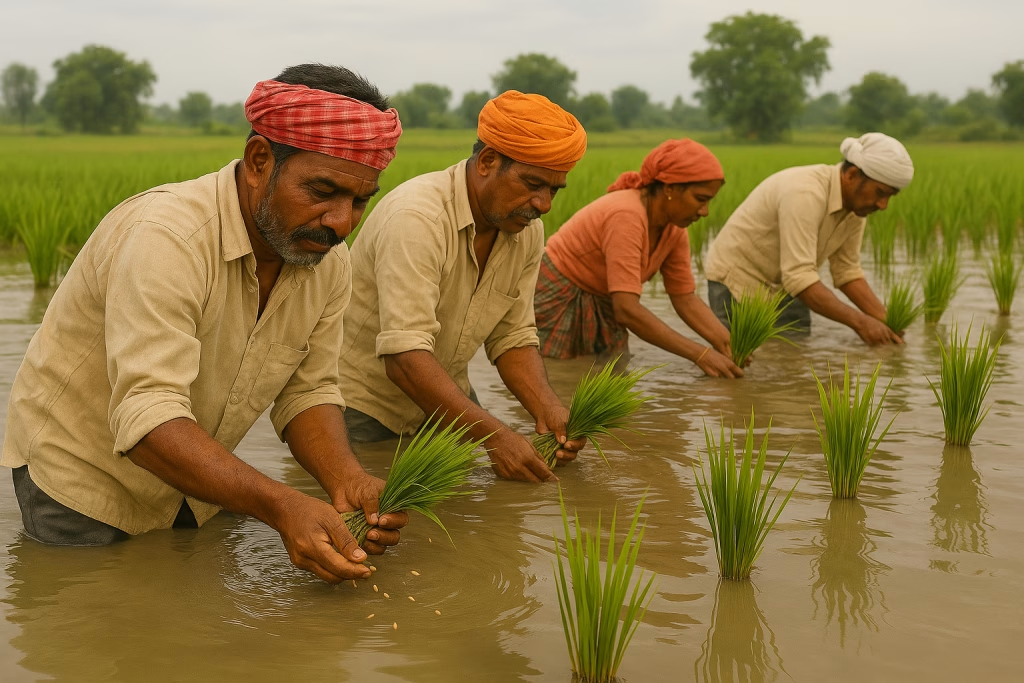
1. Paddy (Rice)
- Sowing Time: Primarily June to mid-July, coinciding with good monsoon rains. Transplanting often happens 20-25 days after nursery sowing.
- Requirements: Requires high rainfall and standing water during the growing period. Thrives in hot and humid conditions.
- Key Consideration: Choose high-yielding, disease-resistant Kharif paddy varieties.
2. Maize (Corn)
- Sowing Time: Mid-June to mid-July, often after initial monsoon showers.
- Requirements: Needs well-distributed rainfall; sensitive to waterlogging.
- Key Consideration: Select hybrid maize varieties for better yield and pest resistance.
- Krushi Vikas Tip: Our hybrid maize seeds offer excellent germination rates and adaptability.
3. Cotton
- Sowing Time: Late May to July, depending on the region’s specific monsoon arrival.
- Requirements: Requires moderate rainfall during initial growth but dry weather during boll development and harvesting.
- Key Consideration: Proper pest management is crucial for Kharif cotton.
- Krushi Vikas Tip: Pair our quality cotton seeds with our effective pest solutions like Shayoclaim or Emimol to protect your crop.
4. Pulses (Arhar/Tur, Urd Bean/Blackgram, Moong Bean/Greengram)
- Sowing Time: Typically June to early July.
- Requirements: Generally drought-tolerant compared to paddy, but good moisture is needed for germination and initial growth.
- Key Consideration: Pulses enrich soil nitrogen; they are excellent for crop rotation.
- Krushi Vikas Tip: High-quality pulse seeds from Krushi Vikas ensure strong germination and healthy plant development.
5. Oilseeds (Soybean, Groundnut/Peanut)
- Sowing Time: June to mid-July.
- Requirements: Groundnut needs well-drained, sandy loamy soil and sufficient moisture during pod formation. Soybean is relatively adaptable.
- Key Consideration: Good soil preparation is fundamental for oilseed development.
- Krushi Vikas Tip: Improve your soil structure and nutrient availability with Bhumi Gold Soil Conditioner before sowing your oilseeds.
🌱 Essential Practices for a Successful Kharif Season
Firstly, soil preparation is fundamental. Before sowing, ensure your field is properly tilled and levelled. Furthermore, conduct a soil test to understand nutrient deficiencies and adjust your fertilization plan accordingly. This step is critical for optimal root development and nutrient uptake.
Next, select the right seeds. High-quality, certified seeds are crucial for strong germination, uniform growth, and higher yields. Therefore, investing in good seeds from a trusted source like Krushi Vikas can significantly impact your harvest.
In addition, effective water management is key. While Kharif crops rely on monsoon rains, contingency plans for dry spells or excessive rainfall are wise. Consequently, consider micro-irrigation systems where feasible, or ensure proper drainage to prevent waterlogging.
Moreover, integrate robust pest and disease management. The humid Kharif season often brings increased pest activity and disease outbreaks. Hence, adopt Integrated Pest Management (IPM) practices. Use pesticides like Red Killer (for broader spectrum control) or Shayoclaim / Emimol (for specific pests) judiciously and only when necessary. Learn more about common pests here: Blog Link.
Finally, stay informed. Monitor weather forecasts closely and connect with local agricultural experts. Similarly, keep an eye on government advisories and schemes that can provide financial support or guidance, such as the PM-KISAN or PMFBY crop insurance (Read our guide: https://krushivikas.co.in/blog/government-schemes-indian-farmers-guide/).
🚀 Partner with Krushi Vikas for Your Kharif Success
A successful Kharif season means prosperity for you and the nation. By combining timely sowing with quality inputs and smart farming practices, you can maximize your yields. At Krushi Vikas, we are dedicated to supplying Indian farmers with superior Kharif seeds, effective soil conditioners, and targeted pest management solutions.
Ultimately, your success is our mission. Contact us today or explore our range of agro products to equip your farm for a highly productive Kharif season.
📞 Got Questions on Kharif Sowing or Our Products?
- Explore All Krushi Vikas Agro Products: Find everything you need for a thriving farm.
- Connect with our Krushi Vikas team on WhatsApp! Call us at 8000004423. We’re here to help you navigate your farming challenges and seize opportunities.
FAQ Block: Kharif Crop Sowing❓
Q1: What are the main factors to consider before Kharif sowing? A: Key factors include the accurate prediction of monsoon onset, soil type, previous crop history, water availability, and the market demand for specific Kharif crops.
Q2: Is crop insurance necessary for Kharif crops? A: Yes, absolutely. Kharif crops are highly dependent on monsoon rains, which can be unpredictable. Crop insurance schemes like PMFBY provide a crucial safety net against unforeseen losses due to natural calamities.
Q3: How often should I test my soil for Kharif season? A: It’s generally recommended to test your soil every 2-3 years, or before each major cropping season like Kharif, especially if you’re experiencing yield issues or plan significant changes in crop rotation.
Q4: Can I use hybrid seeds for all Kharif crops? A: Hybrid seeds are available for many Kharif crops like maize, cotton, and some paddy varieties, offering advantages in terms of yield and disease resistance. However, their suitability depends on local agro-climatic conditions and specific farming practices. Always consult with local experts.
External References for Further Reading:
- Ministry of Agriculture & Farmers Welfare, Govt. of India: https://agri.nic.in/
- India Meteorological Department (IMD) – for monsoon forecasts: https://mausam.imd.gov.in/
- MyScheme Portal (Government of India) – for relevant schemes: https://www.myscheme.gov.in/
This guide was compiled by the dedicated team at Krushi Vikas. Passionate about empowering the Indian farming community, we strive to provide reliable information and top-quality agricultural products that help farmers thrive. We believe informed farmers are empowered farmers.